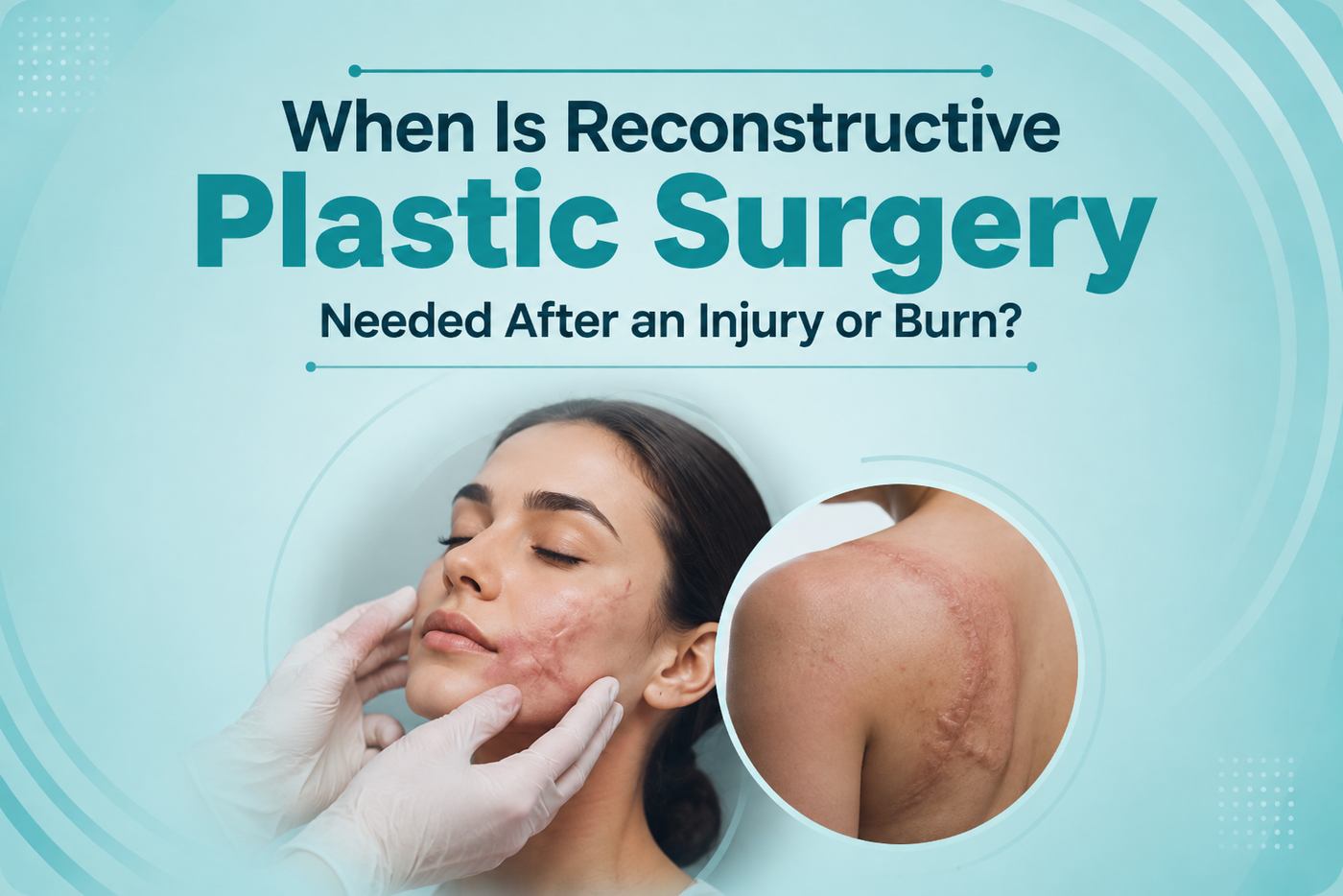
When is reconstructive plastic surgery needed after an injury or burn? It may be recommended when an injury, burn, scar, or tissue loss affects appearance, movement, function, or quality of life. For people seeking appropriate treatment options in Thrissur, understanding when reconstruction becomes necessary can help with timely medical evaluation.
Reconstructive plastic surgery focuses on restoring damaged tissues and improving function rather than simply changing appearance. Depending on the severity and location of the injury, treatment may involve scar revision, skin grafting, tissue reconstruction, flap surgery, or microsurgery.
The need for reconstruction varies from person to person. Some wounds heal naturally with appropriate wound care, while deeper injuries may leave permanent changes that require surgical correction.
When Is Reconstructive Plastic Surgery Needed After an Injury or Burn
Reconstructive plastic surgery may become necessary when an injury or burn causes significant tissue damage that cannot heal properly on its own.
Common situations include:
- Severe burns involving deeper layers of skin
- Large areas of missing or damaged skin
- Traumatic wounds caused by accidents
- Facial injuries affecting appearance or function
- Hand injuries limiting movement
- Deep scars causing tightness or restricted motion
- Wounds that remain open or heal poorly
- Tissue damage around joints
- Contractures that restrict normal movement
- Injuries resulting in permanent deformity
The primary goal is to restore the affected area as safely and effectively as possible. Reconstruction may also help protect underlying tissues and improve the patient’s ability to perform everyday activities.
How Severe Injuries Can Damage Skin and Tissue
Injuries and burns can damage the skin at different depths. A minor injury may affect only the outer layer of skin, while a severe wound can damage skin, fat, muscles, nerves, blood vessels, and other structures.
Burn injuries are commonly classified according to their depth. Superficial burns may heal without surgery, while deeper burns may destroy skin and require reconstruction.
Traumatic injuries can create similar problems. A road accident, workplace injury, fall, or machinery-related injury may cause tissue loss or extensive wounds.
The deeper and larger the injury, the greater the possibility that reconstructive treatment may be needed.
Signs That Reconstruction May Be Necessary
Certain symptoms or physical changes may indicate that further reconstructive evaluation is appropriate.
Restricted Movement
A scar that crosses a joint can become tight as it heals. This may make it difficult to bend or straighten the affected area.
Persistent Wound Problems
A wound that does not close properly or repeatedly breaks down may require specialized reconstruction.
Significant Tissue Loss
Large areas of missing skin or soft tissue may not be suitable for simple closure.
Severe Scarring
Raised, contracted, or extensive scars can affect both appearance and physical function.
Deformity
An injury may change the shape or structure of the face, hand, ear, breast, or another body area.
Functional Difficulty
When an injury interferes with walking, grasping, facial movement, eating, speaking, or other activities, reconstruction may be considered.
These signs do not automatically mean surgery is required. A qualified medical evaluation is necessary to determine the most appropriate treatment.
Reconstructive Plastic Surgery After Burn Injuries
Burns are one of the common reasons patients may eventually need reconstructive treatment.
Severe burns can destroy significant amounts of skin and may cause scarring during healing. As scars mature, they can become tight and restrict movement. Burns involving the face, hands, neck, arms, legs, or joints may create particularly important functional concerns.
Reconstructive treatment after a burn may include:
- Skin grafting
- Scar revision
- Contracture release
- Flap reconstruction
- Tissue expansion
- Microsurgical reconstruction
- Local tissue rearrangement
Treatment timing depends on the patient’s wound condition, healing progress, overall health, and the type of reconstruction required.
In some cases, reconstruction is performed after the initial burn wound has healed. In other situations, early surgical intervention may be necessary to protect function or cover exposed structures.
Reconstructive Plastic Surgery After Traumatic Injuries
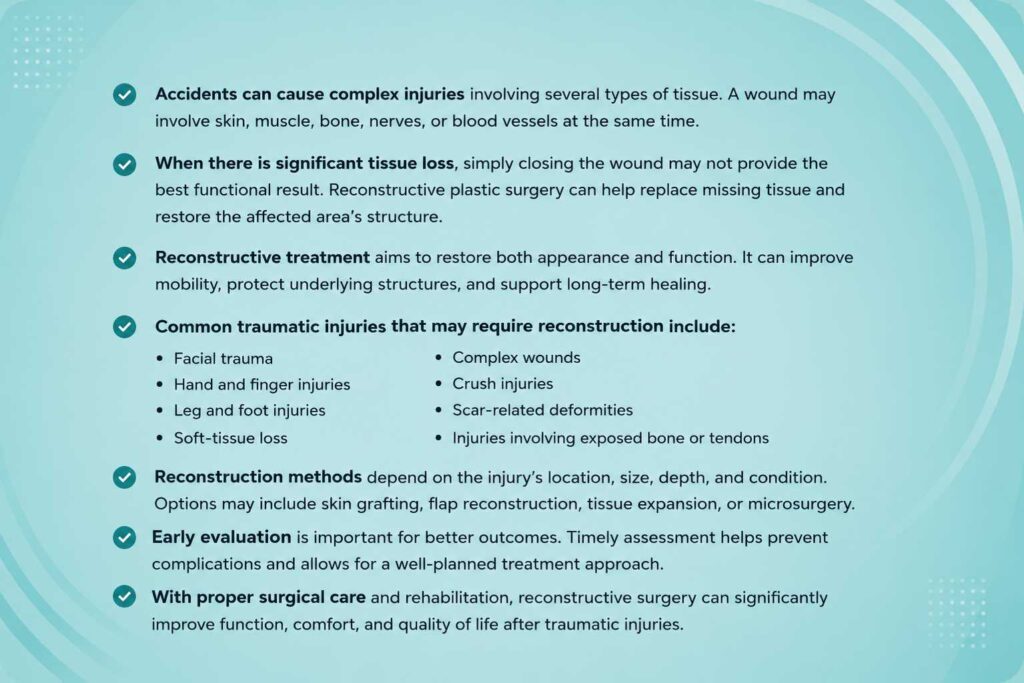
Accidents can cause complex injuries involving several types of tissue. A wound may involve skin, muscle, bone, nerves, or blood vessels at the same time.
When there is significant tissue loss, simply closing the wound may not provide the best functional result. Reconstructive plastic surgery can help replace missing tissue and restore the affected area’s structure.
Examples include:
- Facial trauma
- Hand and finger injuries
- Leg and foot injuries
- Soft-tissue loss
- Complex wounds
- Crush injuries
- Scar-related deformities
- Injuries involving exposed bone or tendons
The reconstruction method depends heavily on the location, size, depth, and condition of the wound.
Types of Reconstructive Procedures Used
Several surgical techniques may be used depending on the injury.
Skin Grafting
A skin graft involves transferring healthy skin from one area of the body to another area that needs coverage.
Skin grafts are commonly considered when there is a large area of skin loss but the deeper tissues remain suitable for coverage.
Flap Surgery
A flap uses tissue that contains its own blood supply. The tissue may be moved from a nearby or distant area to cover a wound.
Flaps can provide skin and, depending on the technique, underlying fat, muscle, or other tissue.
Scar Revision
Scar revision may improve a problematic scar when it causes functional limitation, significant tightness, or an unfavorable contour.
Contracture Release
A contracture occurs when scar tissue becomes tight and restricts movement. Surgical release can help restore mobility in selected cases.
Microsurgery
Microsurgical reconstruction may be used for complex tissue loss. Surgeons can connect very small blood vessels and, when necessary, nerves to support transferred tissue.
The appropriate technique is selected after assessing the wound and the patient’s individual needs.
How Reconstructive Surgery Can Restore Function
One of the most important goals of reconstructive plastic surgery is functional restoration.
A scar around the elbow, knee, wrist, fingers, or neck can interfere with normal movement. Similarly, facial injuries can affect important functions such as eyelid closure, facial movement, or oral function.
Reconstruction may help:
- Improve range of motion
- Protect exposed tissues
- Restore soft-tissue coverage
- Improve hand or limb function
- Reduce scar-related tightness
- Restore structural support
- Improve facial symmetry
- Support normal daily activities
Functional improvement is usually considered alongside appearance. The aim is to achieve a durable result that supports both physical function and quality of life.
Benefits of Reconstructive Plastic Surgery
The potential benefits depend on the injury and procedure, but reconstruction can provide several important advantages.
Improved Physical Function
Reducing scar tightness or restoring missing tissue may improve movement and physical ability.
Better Wound Coverage
Reconstruction can provide coverage for areas where natural healing is insufficient.
Reduced Deformity
Surgical reconstruction can improve changes in shape caused by tissue loss or severe scarring.
Improved Scar Appearance
Some reconstructive procedures can make scars less noticeable or improve their position and contour.
Greater Comfort
Contractures and abnormal scars can sometimes cause discomfort, pulling, or sensitivity. Appropriate reconstruction may help address these issues.
Improved Quality of Life
Restoring function and appearance can make everyday activities easier and may support emotional well-being.
The benefits should always be discussed with the treating surgical team because outcomes depend on the injury, healing capacity, surgical technique, and aftercare.
What Happens Before Reconstructive Surgery
Before surgery, the medical team generally evaluates the injury carefully.
The assessment may include:
- Examination of the wound and scar
- Evaluation of skin quality
- Assessment of movement and function
- Review of previous treatments
- Evaluation of blood supply
- Assessment of nerve or muscle involvement
- Review of general health
- Discussion of treatment goals
In complex injuries, imaging or additional investigations may be recommended.
The surgeon may also discuss whether surgery should be performed immediately, after the wound has stabilized, or after a period of scar maturation.
Good preparation is important because reconstruction often requires careful planning.
Recovery After Reconstructive Plastic Surgery
Recovery depends on the procedure and the extent of tissue damage.
Some patients may recover relatively quickly after a smaller procedure, while complex flap or microsurgical reconstruction may require a longer recovery period.
After surgery, patients may need:
- Wound care
- Dressings
- Medication as prescribed
- Physical therapy
- Scar management
- Activity restrictions
- Follow-up appointments
Following postoperative instructions is essential for proper healing.
Physical therapy can be particularly important when reconstruction involves a joint or an area where movement has been restricted by scarring.
Patients should not return to strenuous activities until the surgical team confirms that it is safe.
Important Factors That Affect Treatment Decisions
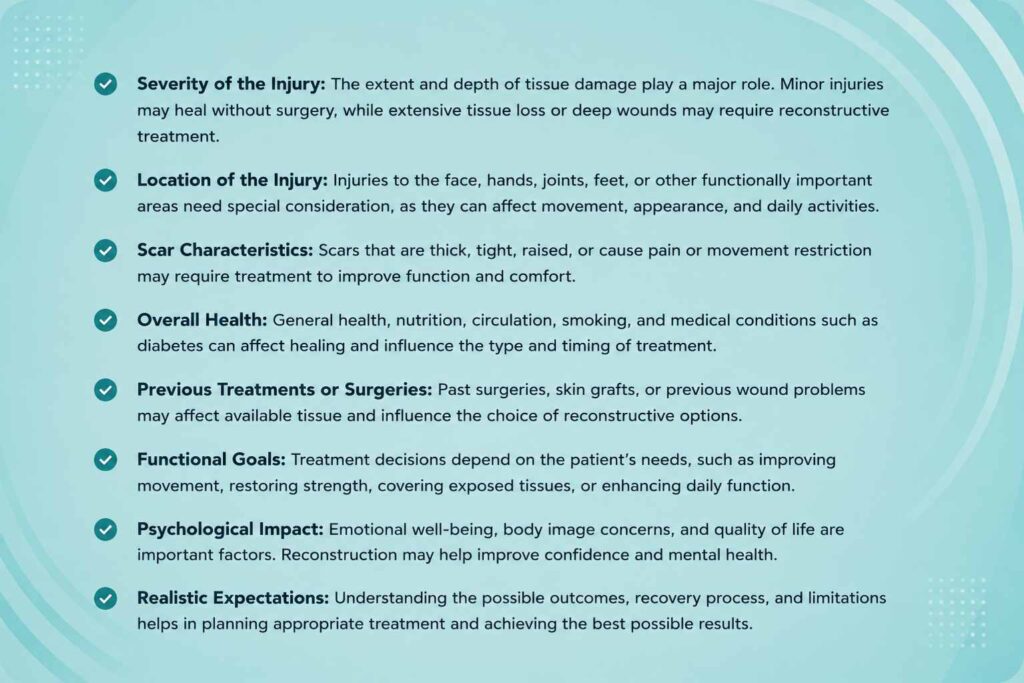
Not every injury requires reconstructive surgery. Several factors influence the decision.
Severity of the Injury
A small superficial wound may heal naturally, whereas extensive tissue loss may require surgery.
Location
Injuries involving the face, hands, feet, joints, or other functionally important areas may require more specialized reconstruction.
Scar Characteristics
Thick, tight, painful, or restrictive scars may require treatment when they interfere with movement or function.
Overall Health
Healing can be affected by general health, nutrition, smoking, circulation, and certain medical conditions.
Previous Surgery
Earlier procedures may affect the available tissue and influence reconstruction options.
Functional Goals
The surgical plan should consider what the patient needs to regain, such as movement, strength, protection, or normal daily function.
Tips for Supporting Recovery
Recovery after reconstructive plastic surgery requires patience and consistent care.
Useful general measures include:
- Follow wound-care instructions carefully.
- Attend scheduled follow-up appointments.
- Take prescribed medicines according to instructions.
- Avoid smoking because it can impair wound healing.
- Maintain adequate nutrition and hydration.
- Protect healing skin from unnecessary trauma.
- Complete recommended physical therapy.
- Avoid stretching or strenuous activity until cleared.
- Follow scar-care instructions provided by the medical team.
- Report unusual swelling, bleeding, wound opening, fever, or worsening pain promptly.
Recovery is not always linear. Some swelling, sensitivity, and changes in scar appearance can continue for months as tissues mature.
When Should You Seek a Reconstructive Evaluation
A reconstructive evaluation may be appropriate if an old or recent injury continues to cause functional or structural problems.
Consider seeking medical assessment when:
- A scar restricts movement.
- A burn scar is becoming increasingly tight.
- An injury has resulted in significant tissue loss.
- A wound is difficult to close.
- There is persistent deformity after healing.
- A previous repair has left functional limitations.
- An injury affects hand, facial, or limb function.
- Scar tissue causes ongoing discomfort.
- You are unsure whether further reconstruction is possible.
Early evaluation can help identify available treatment options. However, the appropriate timing varies according to the injury and healing stage.
What Results Can You Expect
Reconstructive plastic surgery aims to improve function, structure, and appearance, but results vary.
The outcome can depend on:
- Extent of the original injury
- Depth of tissue damage
- Location of the wound
- Type of reconstruction
- Blood supply
- Healing response
- Presence of infection
- Scar formation
- Rehabilitation
- Individual health factors
The goal is not always to make the affected area look exactly as it did before the injury. Instead, reconstruction aims to achieve the best practical improvement possible while restoring useful function and tissue coverage.
Patients should have realistic expectations and understand that more than one procedure may sometimes be necessary.
Understanding the Long-Term Role of Reconstruction
Reconstructive care does not necessarily end when the wound closes. Scars can continue changing for many months, and functional problems may become more noticeable as tissues mature.
Some patients may require additional treatments such as scar management, physical therapy, laser-based scar treatment, or revision surgery.
Long-term follow-up allows the medical team to assess healing and determine whether additional intervention could provide meaningful improvement.
When asking when is reconstructive plastic surgery needed after an injury or burn, it is important to consider both immediate wound healing and long-term function. Reconstruction may be useful when an injury has left a lasting physical problem that cannot be adequately addressed through routine wound care alone.
Conclusion
When is reconstructive plastic surgery needed after an injury or burn? It is generally considered when damage has caused tissue loss, difficult wounds, severe scarring, deformity, restricted movement, or other lasting functional problems. Treatment may involve skin grafts, flap reconstruction, scar revision, contracture release, or microsurgical techniques depending on the injury.
A timely evaluation can help determine whether reconstruction is appropriate and which approach may provide the best functional and structural outcome. For patients considering treatment in Thrissur, an individualized assessment is important because every injury and burn heals differently. According to the American Society of Plastic Surgeons (ASPS), reconstructive surgery can help restore function and appearance after trauma, burns, and other tissue damage.
Frequently Asked Questions
Sushrutha Institute of Plastic, Reconstructive & Aesthetic Surgery
Dr Pradeep Kumar
Plastic, Reconstructive & Aesthetic Surgeon
SIPRAS, Elite Mission Hospital, Thrissur