The Top Cosmetic Surgery Procedures You Should Know include treatments designed to improve facial balance, body proportions, comfort, and personal confidence. People considering cosmetic surgery in Kerala may explore different options based on their anatomy, health, lifestyle, and expectations. However, no single procedure is suitable for everyone. A detailed consultation with a qualified plastic surgeon is essential before deciding whether surgery is appropriate.
Modern cosmetic surgery is not simply about changing appearance. It involves careful assessment, realistic planning, patient safety, surgical precision, and structured recovery. Understanding the Top Cosmetic Surgery Procedures You Should Know can help you ask better questions, compare suitable treatments, and make an informed decision without depending on trends or unrealistic promises.
What Is Cosmetic Surgery?
Cosmetic surgery is a branch of plastic surgery that focuses on improving a person’s appearance through carefully planned surgical procedures. It may address facial proportions, changes caused by ageing, body contours, unwanted fat deposits, loose skin, or concerns related to the size and shape of particular features.
Unlike reconstructive surgery, which primarily restores form or function following trauma, illness, burns, or congenital conditions, cosmetic surgery is usually chosen to improve aesthetic appearance. However, certain procedures may offer both cosmetic and functional benefits.
For example:
- Rhinoplasty may improve facial balance and sometimes support nasal function.
- Breast reduction may improve proportions while reducing physical discomfort.
- Eyelid surgery may refresh the eye area and, in selected cases, reduce visual obstruction.
- Tummy tuck surgery may address loose skin and separated abdominal muscles.
- Hair restoration may improve the appearance of areas affected by hair thinning.
Learning about the Top Cosmetic Surgery Procedures You Should Know allows patients to understand what each treatment can and cannot achieve.
Why Do People Consider Cosmetic Surgery?
People consider cosmetic surgery for many personal reasons. The decision may be influenced by natural anatomy, ageing, pregnancy, weight changes, genetic factors, previous surgery, injuries, or a long-standing concern about a particular feature.
Common reasons include:
- Improving facial or body proportions
- Addressing loose skin after weight loss
- Restoring contours after pregnancy
- Reducing stubborn fat deposits
- Improving the appearance of ageing features
- Correcting visible asymmetry
- Restoring lost volume
- Improving comfort during physical activity
- Addressing changes following previous surgery
- Feeling more comfortable with personal appearance
A responsible surgeon will explore why the patient wants treatment and whether the expected outcome is realistic. Cosmetic surgery should be a personal and informed choice rather than a response to pressure from other people.
Signs and Concerns That May Lead to Cosmetic Surgery
Cosmetic concerns are not medical symptoms in the same way as an illness. However, certain physical changes or functional difficulties may encourage someone to seek a professional consultation.
These may include:
- Loose or hanging skin after major weight loss
- Persistent fat deposits despite a stable lifestyle
- Changes in abdominal contour after pregnancy
- Drooping upper eyelid skin
- Facial volume loss associated with ageing
- A nose shape that appears out of balance with other facial features
- Changes in breast position, volume, or proportion
- Discomfort associated with excessive breast weight
- Loose upper-arm skin
- Hair thinning or patterned hair loss
- Visible facial or body asymmetry
- Scars that affect appearance or movement
These concerns do not automatically mean that surgery is needed. A consultation helps determine whether surgery, a non-surgical option, lifestyle management, observation, or no treatment is the most appropriate choice.
Types of Cosmetic Surgery Procedures
The Top Cosmetic Surgery Procedures You Should Know can be grouped into several major categories.
Facial Cosmetic Surgery
Facial procedures are designed to improve balance, shape, volume, or signs of ageing while preserving natural expressions. Examples include rhinoplasty, facelift surgery, blepharoplasty, facial fat grafting, and ear reshaping.
Body Contouring Surgery
Body contouring procedures reshape selected areas by removing excess fat, tightening loose skin, or improving body proportions. Liposuction, tummy tuck surgery, arm lift surgery, and post-weight-loss contouring belong to this category.
Breast Cosmetic Surgery
Breast procedures may increase volume, reduce size, improve position, correct asymmetry, or reshape tissue. Common options include breast implant surgery, breast reduction, and breast lift surgery.
Hair Restoration Procedures
Hair restoration treatments may be considered by suitable individuals experiencing permanent or patterned hair loss. The treatment plan depends on the cause of hair loss, donor hair availability, scalp condition, and long-term progression.
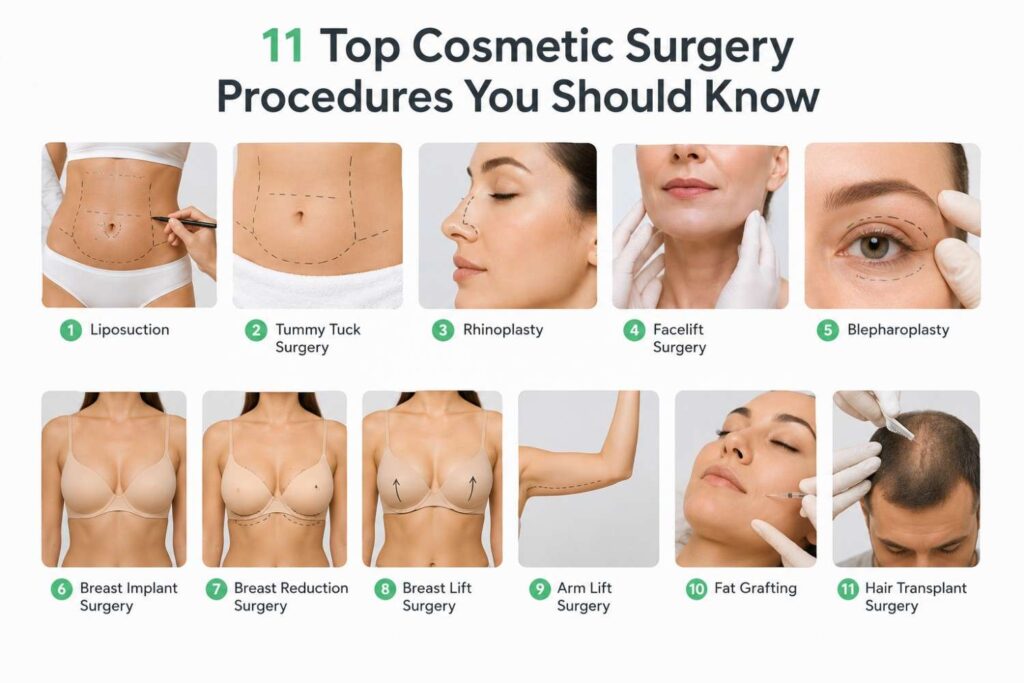
11 Top Cosmetic Surgery Procedures You Should Know
1. Liposuction
Liposuction is one of the Top Cosmetic Surgery Procedures You Should Know when exploring body-contouring options. It removes selected deposits of fat using a thin surgical tube known as a cannula.
The procedure may be performed on areas such as the:
- Abdomen
- Waist
- Hips
- Thighs
- Upper arms
- Back
- Chin or neck region
Liposuction is not a weight-loss treatment. It is generally considered for people who are near a stable body weight but have localized fat deposits that remain despite diet and physical activity.
Different techniques may be used depending on the treatment area, skin quality, fat distribution, and surgeon’s assessment. Results are influenced by healing, skin elasticity, weight stability, and post-operative care.
2. Tummy Tuck Surgery
A tummy tuck, medically known as abdominoplasty, removes excess abdominal skin and may tighten separated or weakened muscles. It is commonly considered after pregnancy, major weight loss, or significant changes in body shape.
A tummy tuck may help address:
- Loose abdominal skin
- A lower abdominal overhang
- Separated abdominal muscles
- Changes around the navel
- Poor abdominal contour that does not improve with exercise
A tummy tuck is more extensive than liposuction. Liposuction primarily targets fat, while abdominoplasty focuses on excess skin and abdominal structure. In selected cases, both procedures may be combined.
Recovery usually includes temporary swelling, activity restrictions, wound care, compression garments, and follow-up appointments.
3. Rhinoplasty
Rhinoplasty is a surgical procedure that reshapes the nose. It is one of the most widely recognized treatments among the Top Cosmetic Surgery Procedures You Should Know because the nose plays an important role in overall facial balance.
Rhinoplasty may address:
- A prominent nasal bridge
- A wide or uneven nose
- A drooping or enlarged nasal tip
- Visible asymmetry
- Changes following an injury
- Concerns related to facial proportions
Some patients may also require assessment of nasal breathing. Cosmetic changes and functional concerns must be evaluated carefully because the external shape and internal structure of the nose are closely connected.
Final rhinoplasty results develop gradually as swelling settles. Patients should understand that small differences and natural asymmetry may remain.
4. Facelift Surgery
Facelift surgery addresses visible signs of ageing in the lower face and neck. It may reposition deeper tissues, remove selected excess skin, and improve facial contours.
A facelift may be considered for:
- Lower-face sagging
- Reduced jawline definition
- Loose neck skin
- Deep facial folds
- Changes caused by tissue descent
A facelift does not stop the ageing process. Its purpose is to create a refreshed and balanced appearance without making the face look unnaturally tight.
The procedure may be combined with eyelid surgery, fat grafting, or another treatment when clinically appropriate. The surgeon will recommend a plan based on facial structure, skin quality, age-related changes, and recovery expectations.
5. Blepharoplasty
Blepharoplasty, commonly called eyelid surgery, reshapes the upper eyelids, lower eyelids, or both. It may remove or reposition excess skin and fat to create a more rested appearance.
Common reasons for considering blepharoplasty include:
- Loose upper-eyelid skin
- Puffiness around the eyes
- Prominent under-eye bags
- Uneven eyelid contours
- A tired appearance that persists despite adequate rest
In some individuals, heavy upper-eyelid skin may affect the upper field of vision. Such cases require a detailed medical and eye assessment.
Temporary swelling and bruising are common after eyelid surgery. Patients must follow instructions regarding eye care, activity, medication, and follow-up.
6. Breast Implant Surgery
Breast implant surgery increases breast volume and may improve body proportions. Implants are available in different sizes, shapes, profiles, and materials.
Selecting an implant involves more than choosing a cup size. The surgeon may evaluate:
- Chest width
- Existing tissue
- Skin elasticity
- Breast base dimensions
- Natural asymmetry
- Shoulder and waist proportions
- Implant width and projection
- The patient’s preferred result
Breast implant surgery is among the Top Cosmetic Surgery Procedures You Should Know, but it requires realistic expectations and an understanding of long-term considerations. Implants are medical devices and may require monitoring, revision, or replacement in the future.
7. Breast Reduction Surgery
Breast reduction surgery removes selected skin, fat, and glandular tissue to reduce breast size and improve proportion. It may be considered by individuals experiencing physical discomfort or limitations related to excessive breast weight.
Possible concerns include:
- Neck or shoulder discomfort
- Shoulder grooves from clothing straps
- Skin irritation beneath natural folds
- Difficulty exercising comfortably
- Challenges finding properly fitting clothing
- Disproportion between the chest and overall body frame
Breast reduction treatment is carefully customized. The location and appearance of scars depend on the surgical technique, the amount of reduction, and the patient’s anatomy.
The procedure may improve comfort and balance, but healing varies from person to person.
8. Breast Lift Surgery
A breast lift, also known as mastopexy, reshapes and elevates breast tissue. It is designed primarily to improve position rather than significantly increase or decrease volume.
A breast lift may be considered after:
- Pregnancy
- Breastfeeding
- Weight changes
- Age-related tissue changes
- Loss of skin elasticity
- Natural changes in breast position
Some patients may require a lift alone, while others may discuss combining it with implants or reduction surgery. The correct option depends on tissue quality, volume, desired position, and personal goals.
Scarring is an important part of the discussion. Patients should understand where scars are likely to be placed and how they may change over time.
9. Arm Lift Surgery
An arm lift, or brachioplasty, removes excess skin and reshapes the upper arms. It may be considered after significant weight loss or when loose skin does not improve through exercise.
The procedure may address:
- Hanging upper-arm skin
- Reduced arm definition
- Skin folds after weight loss
- Discomfort caused by excess skin
- Difficulty wearing certain clothing
An arm lift can create a smoother contour, but it also results in a visible scar along part of the upper arm. The surgeon should explain scar placement, expected improvement, recovery needs, and possible limitations before treatment.
10. Fat Grafting
Fat grafting transfers fat from one area of the body to another. Fat is usually removed through liposuction, processed, and carefully injected into an area requiring additional volume.
It may be used for:
- Facial volume restoration
- Improving selected contour irregularities
- Correcting certain asymmetries
- Supporting reconstructive treatment
- Enhancing soft-tissue volume
Fat grafting is one of the Top Cosmetic Surgery Procedures You Should Know because it uses the patient’s own tissue. However, not all transferred fat survives permanently. Some volume may be naturally absorbed, and additional treatment may occasionally be required.
Outcomes depend on the treatment area, tissue quality, technique, blood supply, and individual healing.
11. Hair Transplant Surgery
Hair transplant surgery moves suitable hair follicles from a donor area to an area affected by permanent hair loss. It is commonly considered for patterned hair loss when adequate donor hair is available.
Before recommending surgery, the clinician may assess:
- The cause of hair loss
- The pattern and progression of thinning
- Donor hair density
- Scalp health
- Age and medical history
- Previous treatments
- Long-term hair-loss expectations
Hair transplantation does not prevent untreated hair from continuing to thin. A long-term plan may therefore include medical evaluation, hair-loss management, and follow-up.
Visible growth develops gradually because transplanted follicles follow natural hair-growth cycles.
Benefits of the Top Cosmetic Surgery Procedures You Should Know
The possible benefits of cosmetic surgery vary according to the procedure and the patient’s goals.
Potential benefits may include:
- Improved facial balance
- Better body proportions
- Reduction of excess skin
- More defined contours
- Improved clothing comfort
- Restoration of lost volume
- Correction of selected asymmetries
- Improved comfort during physical activity
- A refreshed appearance
- Greater confidence in personal appearance
Results cannot be guaranteed. The quality of the outcome depends on anatomy, health, surgical planning, technique, healing, lifestyle, and adherence to post-operative guidance.
Tips for Choosing the Right Cosmetic Procedure
Understanding the Top Cosmetic Surgery Procedures You Should Know is only the beginning. Selecting the right treatment requires thoughtful decision-making.
Choose a Qualified Plastic Surgeon
Review the surgeon’s training, professional qualifications, relevant experience, and approach to patient safety.
Select an Appropriate Surgical Facility
The hospital or surgical centre should have suitable operating facilities, trained clinical staff, emergency support, monitoring systems, and structured recovery care.
Ask About Alternatives
Surgery may not always be necessary. Ask whether observation, lifestyle changes, skin treatments, non-surgical procedures, or another surgical option could be appropriate.
Discuss Scars Honestly
Every surgical incision creates a scar. Ask where scars will be located, how long they may remain visible, and how scar care will be managed.
Understand the Recovery Period
Plan sufficient time away from work, exercise, travel, and major social commitments. Returning to normal activities too early may affect healing.
Avoid Choosing Surgery Based Only on Price
The lowest price does not always reflect surgeon expertise, facility standards, anaesthesia support, follow-up care, or treatment complexity.
Maintain Realistic Expectations
Cosmetic surgery may improve a feature, but it cannot create perfection or solve unrelated personal and emotional difficulties.
Conclusion
The Top Cosmetic Surgery Procedures You Should Know include a wide range of facial, body-contouring, breast, and hair-restoration treatments. Each procedure has a different purpose, recovery process, benefit, limitation, and potential risk. Understanding these differences can help you approach cosmetic surgery with clearer expectations.
Before choosing treatment, seek a detailed clinical evaluation, review the surgeon’s qualifications, ask about alternatives, and understand the full recovery plan. Patients considering the Top Cosmetic Surgery Procedures You Should Know in Kerala should prioritize individualized planning, appropriate facilities, realistic goals, and structured post-operative care rather than making decisions based only on trends or price.
To learn more about cosmetic and reconstructive plastic surgery, visit the American Society of Plastic Surgeons (ASPS).
FREQUENTLY ASKED QUESTIONS
Sushrutha Institute of Plastic, Reconstructive & Aesthetic Surgery


Dr Pradeep Kumar
Plastic, Reconstructive & Aesthetic Surgeon
SIPRAS, Elite Mission Hospital, Thrissur