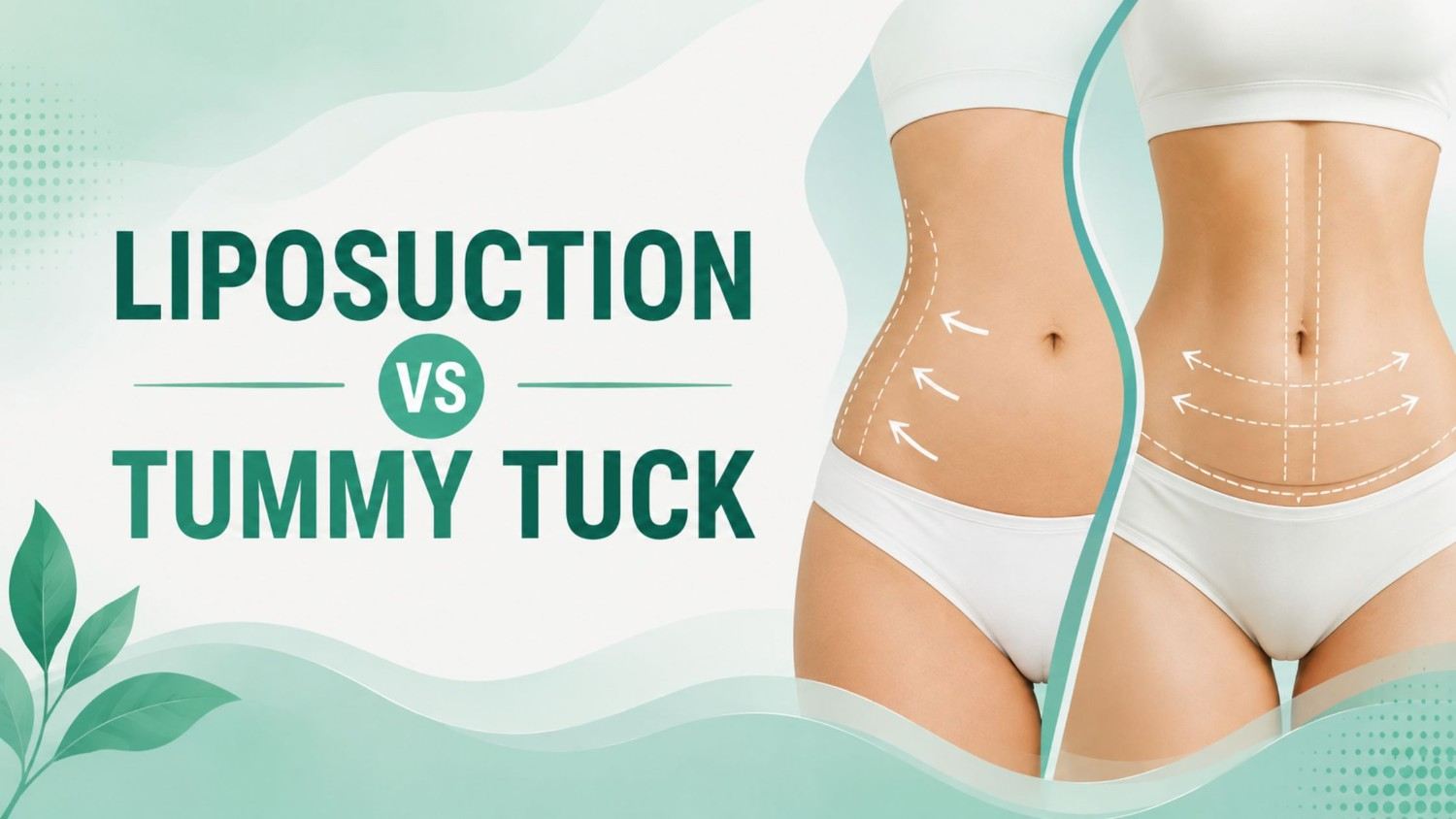
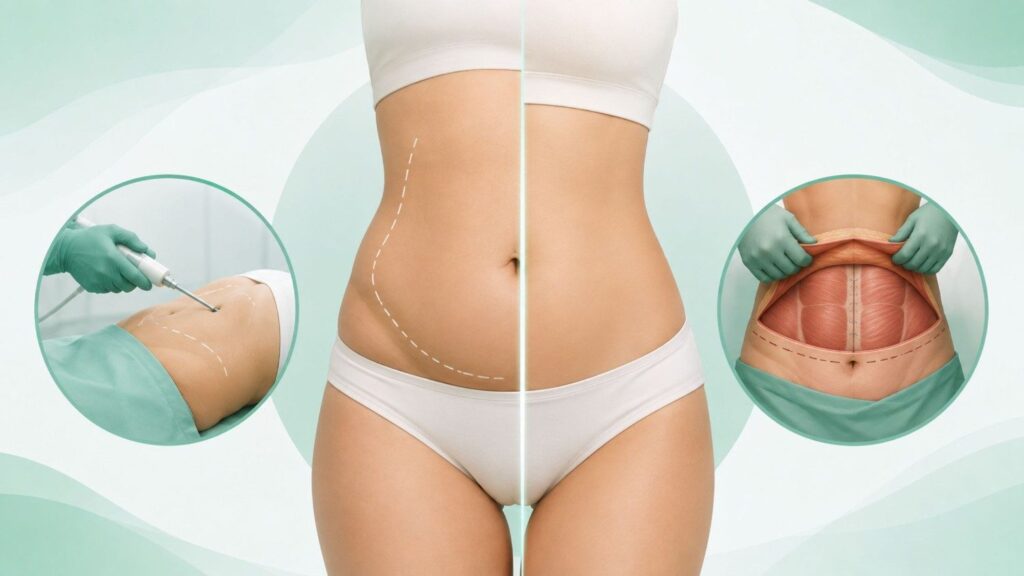
When comparing liposuction vs tummy tuck, it is important to understand that these procedures solve different body-contouring concerns. Liposuction primarily removes localized deposits of subcutaneous fat, while a tummy tuck, also called abdominoplasty, can remove excess abdominal skin and fat and may tighten weakened or separated abdominal muscles.
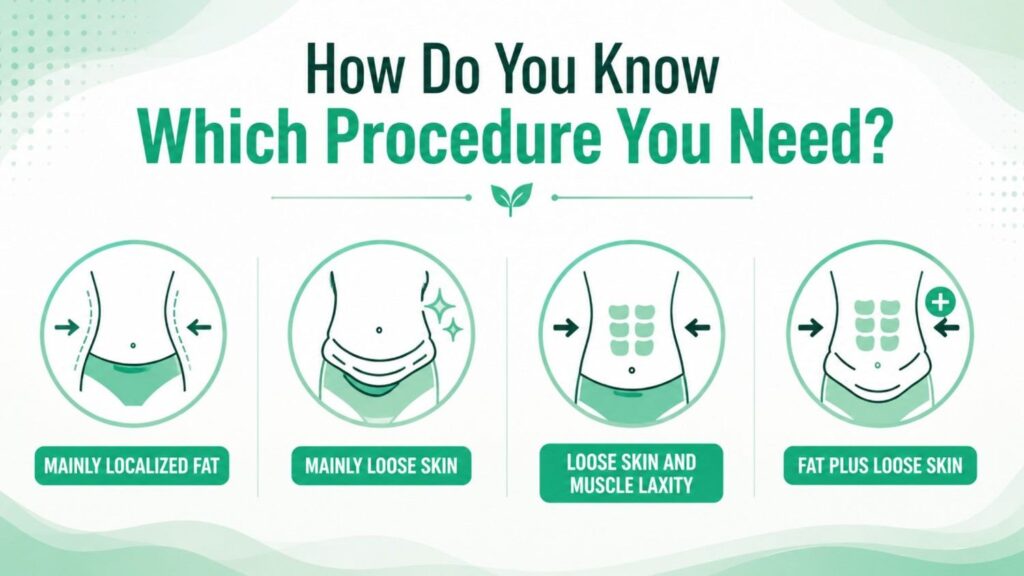
The right choice depends on what is causing the abdominal contour you want to change. If stubborn fat is the main concern and the skin has good elasticity, liposuction may be appropriate. If loose skin, stretch-related changes, or abdominal muscle laxity are significant concerns, a tummy tuck may offer a more suitable approach. In some carefully selected patients, both procedures may be combined.
What Is Liposuction?
Before comparing liposuction vs tummy tuck, it helps to understand what liposuction actually does.
Liposuction is a body-contouring procedure that removes localized deposits of subcutaneous fat using a cannula and suction. It can be used on areas such as the abdomen, waist, hips, thighs, back, arms, chest, chin, and neck.
The procedure is intended to improve body proportions and contour rather than provide general weight loss.
Liposuction can be particularly useful when:
- Localized fat remains despite diet and exercise
- The skin has reasonable elasticity
- There is little excess loose skin
- The underlying abdominal muscles have adequate tone
- The primary concern is excess fat rather than excess tissue
However, liposuction does not remove substantial loose skin or correct abdominal muscle separation. Liposuction is primarily used for body contouring rather than general weight loss. It uses a cannula to remove localized deposits of fat from selected areas, with the technique tailored to the patient’s anatomy and treatment goals. For a more detailed explanation of the procedure, you can read our guide on what is liposuction.
What Is a Tummy Tuck?
A tummy tuck, or abdominoplasty, is a surgical procedure designed to improve the abdominal contour by addressing excess skin and, when appropriate, weakened or separated abdominal muscles.
Depending on the type of abdominoplasty and the individual’s anatomy, the procedure can involve:
- Removing excess abdominal skin
- Removing selected excess fat
- Tightening or repairing abdominal muscles
- Redraping the remaining abdominal skin
- Repositioning the belly button in a full tummy tuck
A tummy tuck is therefore more extensive than liposuction because it can address several structural components of the abdominal area.
It is not intended to serve as a weight-loss procedure. The NHS notes that abdominoplasty is generally considered for people who are at a healthy weight and have concerns such as excess abdominal skin that cannot be removed through exercise.
Liposuction vs Tummy Tuck: The Main Difference
The simplest way to understand liposuction vs tummy tuck is to look at the primary problem each procedure addresses.
| Concern | Liposuction | Tummy Tuck |
|---|---|---|
| Localized fat | Yes | Can address selected fat |
| Excess loose skin | Limited | Yes |
| Significant skin laxity | No | Yes |
| Abdominal muscle laxity | No | Can address it |
| Body contouring | Yes | Yes |
| Large abdominal scar | Usually no | Yes |
| General weight loss | No | No |
What Does Liposuction Treat?
Liposuction is most useful when localized fat is the dominant concern.
For example, a person may have relatively firm abdominal skin but still have a persistent fat deposit around the lower abdomen or waist. In such a situation, removing the localized fat may improve the contour without requiring skin excision.
Liposuction may also be used to contour areas around the abdomen, such as the flanks or waist, when appropriate.
The quality of the overlying skin matters. Skin with good elasticity is more likely to adapt to the reduced volume after fat removal. Softer or significantly lax skin may not contract sufficiently, which can limit the result of liposuction alone.
What Does a Tummy Tuck Treat?
A tummy tuck becomes more relevant when the problem involves excess abdominal tissue rather than fat alone.
It may be considered when there is:
- Significant loose abdominal skin
- A hanging lower-abdominal skin fold
- Skin changes after substantial weight loss
- Abdominal skin laxity following pregnancy
- Weakened or separated abdominal muscles
- A combination of excess skin and localized fat
A full abdominoplasty can involve separating the abdominal skin from the underlying wall, addressing the abdominal muscles when indicated, removing excess skin and fat, and redraping the remaining tissue.
This is why liposuction vs tummy tuck is not simply a question of choosing the more powerful procedure. Each procedure addresses different anatomical problems.
Liposuction vs Tummy Tuck for Belly Fat
This is one of the most common reasons people search for liposuction vs tummy tuck.
If the abdomen has localized fat but relatively good skin tone, liposuction may be enough to improve the contour.
However, if the abdomen has both excess fat and significant loose skin, removing fat alone may leave the excess skin behind.
A tummy tuck can remove the redundant skin while also addressing the abdominal wall when necessary.
The American Society of Plastic Surgeons explains that patients with minimal skin and muscle laxity who primarily need fat reduction may be candidates for liposuction, while patients with moderate to severe skin or muscle laxity may need a tummy tuck.
The key issue is therefore not simply how much fat is present. It is what combination of fat, skin, and muscle changes is present.
Liposuction vs Tummy Tuck for Loose Skin
When comparing liposuction vs tummy tuck for loose skin, the difference is clear.
Liposuction removes fat. It does not function as a skin-removal procedure.
If a person has substantial loose skin after pregnancy or major weight loss, removing the underlying fat may not solve the entire problem. In fact, reducing the volume beneath already-loose skin may leave the excess tissue visible.
A tummy tuck directly addresses excess skin by removing the unwanted tissue and redraping the remaining skin.
The NHS describes abdominoplasty as a procedure that can remove excess loose skin, fat, and stretch marks and tighten abdominal muscles in appropriate cases.
Therefore, when significant skin laxity is the main concern, a tummy tuck may be more appropriate than liposuction alone.
Liposuction vs Tummy Tuck for Abdominal Muscle Laxity
Another major distinction in liposuction vs tummy tuck is the abdominal wall.
Pregnancy, significant weight changes, and other factors can contribute to stretching or separation of the abdominal wall.
Liposuction works in the fatty layer beneath the skin. It does not repair separated abdominal muscles.
A tummy tuck can provide access to the abdominal wall and allow the surgeon to tighten or repair weakened muscles when clinically appropriate.
This is an important reason why someone with a persistent abdominal bulge may not achieve the desired result from liposuction alone.
An abdominal bulge is not always caused by excess fat. A physical examination is needed to determine whether fat, skin laxity, muscle changes, or a combination of these factors is contributing to the appearance.
How Is Liposuction Performed?
Understanding the procedure itself can make the comparison of liposuction vs tummy tuck easier.
Liposuction generally involves small access points through which a thin cannula is introduced into the fatty layer.
The surgeon uses the cannula to loosen and suction localized fat in a controlled manner.
The exact technique may vary depending on:
- Treatment area
- Amount and distribution of fat
- Skin quality
- Surgical goals
- Patient anatomy
- Technology being used
Liposuction can be performed independently or incorporated into other body-contouring procedures when appropriate.
Because the procedure focuses on fat removal rather than skin excision, the incisions are generally much smaller than those required for a tummy tuck.
How Is a Tummy Tuck Performed?
A tummy tuck involves a larger surgical approach because it addresses excess abdominal tissue and may involve the abdominal wall.
A full tummy tuck generally involves an incision across the lower abdomen. The abdominal skin is separated from the abdominal wall, and the surgeon can address muscle laxity when indicated before removing excess skin and redraping the remaining tissue. The belly button may also need to be repositioned during a full procedure.
The exact technique depends on the amount and location of excess skin, the condition of the abdominal wall, previous surgeries, body proportions, and the desired outcome.
There are different forms of abdominoplasty, including full and mini tummy tuck procedures.
A mini tummy tuck generally addresses a more limited area of the lower abdomen, while a full procedure can address a larger portion of the abdominal region.
Which Procedure Leaves a Larger Scar?
When comparing liposuction vs tummy tuck, scar size is another significant difference.
Liposuction usually requires several small incisions that allow the cannula to access the treatment area.
A tummy tuck requires a much larger incision because excess skin needs to be removed and the remaining tissue needs to be repositioned.
The location and length of the tummy tuck scar depend on the surgical technique and individual anatomy. A full tummy tuck generally involves a lower abdominal incision, while a mini tummy tuck can involve a smaller incision.
Anyone considering either procedure should discuss expected scars and scar-care recommendations during the consultation.
Liposuction vs Tummy Tuck Recovery
Recovery is another important part of the liposuction vs tummy tuck decision.
Liposuction generally involves less extensive tissue disruption than a tummy tuck, but recovery still varies according to the number and size of areas treated and the extent of surgery.
Patients may experience:
- Swelling
- Bruising
- Soreness
- Temporary numbness
- Activity restrictions
A tummy tuck is a more extensive operation and typically involves a longer recovery period. Patients may experience abdominal tightness, pain, bruising, swelling, and temporary numbness. The NHS notes that some people have difficulty standing completely upright immediately after surgery and that numbness can persist for months or longer.
Recovery should therefore not be judged solely by the appearance of the incision. Internal healing also takes time.
Can Liposuction and Tummy Tuck Be Combined?
Yes, selected patients may benefit from combining liposuction with a tummy tuck.
This is sometimes referred to as lipoabdominoplasty.
The reason for combining the procedures is straightforward: a tummy tuck can address excess skin and abdominal wall laxity, while liposuction can contour localized fat deposits.
For example, a patient may have loose abdominal skin and a persistent fat deposit around the waist or flanks. Addressing both concerns can create a more balanced overall contour.
However, combination surgery is not automatically appropriate for everyone. The American Society of Plastic Surgeons notes that surgeons need to assess individual anatomy, health, goals, and surgical factors when deciding whether procedures should be performed together or in stages.
Therefore, the answer to liposuction vs tummy tuck is sometimes not “one or the other.”
For selected patients, the answer may be both.
What Factors Affect the Choice?
Several factors influence the decision between liposuction vs tummy tuck.
Skin Elasticity
Good skin elasticity can improve the likelihood of achieving a smooth contour after fat removal.
Amount of Excess Skin
Significant skin excess may require surgical removal rather than fat removal alone.
Abdominal Muscle Condition
Muscle laxity or separation can make a tummy tuck more relevant.
Weight Stability
Major weight changes can affect both the timing of surgery and long-term results.
Pregnancy Plans
Future pregnancy can change abdominal skin, muscles, and body contour.
Previous Surgery
Previous abdominal operations can influence incision placement and surgical planning.
Overall Health
Medical conditions, medications, smoking status, and healing factors need to be assessed before elective surgery.
Personal Goals
Two people with similar anatomy may want different outcomes. One may prioritize fat reduction, while another may be more concerned about loose skin.
This is why liposuction vs tummy tuck should ultimately be decided through an individualized surgical assessment.
Common Misconceptions About Liposuction vs Tummy Tuck
Myth 1: Liposuction and Tummy Tuck Are the Same Procedure
They are not. Liposuction primarily removes localized fat, while a tummy tuck can remove excess skin and address abdominal muscle laxity.
Myth 2: Liposuction Can Remove Loose Skin
Liposuction does not directly remove substantial excess skin. Skin elasticity determines how much the skin can contract after fat removal.
Myth 3: A Tummy Tuck Is a Weight-Loss Procedure
A tummy tuck is designed for body contouring rather than general weight reduction.
Myth 4: Liposuction Is Always Better Because It Has Smaller Incisions
Smaller incisions do not automatically mean a better choice. If significant skin or muscle laxity is present, liposuction alone may not address the underlying concern.
Myth 5: Everyone Needs Both Procedures
Not necessarily. Some people may benefit from liposuction alone, some from a tummy tuck, and selected patients from a combination approach.
Myth 6: A Tummy Tuck Always Requires Muscle Tightening
Not every patient has the same abdominal wall problem. The surgical plan depends on individual anatomy and whether muscle laxity is present.
Conclusion
When comparing liposuction vs tummy tuck, there is no universal winner. The two procedures address different anatomical concerns and can sometimes complement each other.
Liposuction is primarily designed to remove localized fat and improve body contour. It may be appropriate when skin elasticity is reasonably good and excess skin or significant muscle laxity is not the main concern.
The most reliable way to decide between liposuction vs tummy tuck is through a personalized assessment by a qualified plastic surgeon. A proper evaluation can determine whether fat, loose skin, muscle laxity, or a combination of these factors is responsible for the contour you want to change. For additional information about tummy tuck recovery and risks, including activity restrictions, healing, scarring, and potential complications, you can refer to Cleveland Clinic’s detailed guide.
Frequently Asked Questions
Sushrutha Institute of Plastic, Reconstructive & Aesthetic Surgery


Dr Pradeep Kumar
Plastic, Reconstructive & Aesthetic Surgeon
SIPRAS, Elite Mission Hospital, Thrissur