
Understanding How to Choose a Qualified Cosmetic Surgeon is one of the most important steps before considering any cosmetic procedure. A surgeon’s training, practical experience, communication style, safety standards, and approach to aftercare can directly influence your treatment experience and results. For patients researching cosmetic surgery options in Kerala, making a careful and informed choice is far more valuable than selecting a clinic based only on price, advertising, or social media photographs.
What Does a Qualified Cosmetic Surgeon Do?
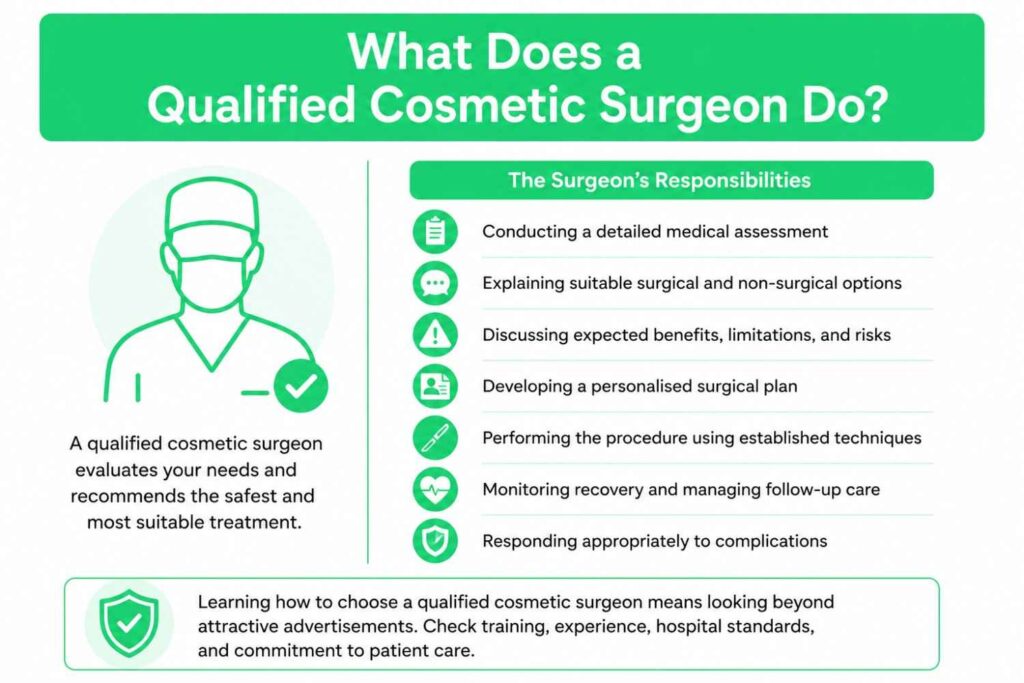
A qualified cosmetic surgeon evaluates a person’s concerns, medical history, physical condition, expectations, and treatment goals before recommending a procedure.
The surgeon’s responsibilities may include:
- Conducting a detailed medical assessment
- Explaining suitable surgical and non-surgical options
- Discussing expected benefits and limitations
- Identifying possible risks
- Developing a personalised surgical plan
- Performing the procedure using established techniques
- Monitoring recovery
- Managing follow-up care
- Responding appropriately to complications
Learning How to Choose a Qualified Cosmetic Surgeon means looking beyond attractive advertisements. You need to understand whether the doctor has appropriate medical training, relevant surgical experience, access to a properly equipped hospital, and a responsible approach to patient care.
Why Choosing the Right Cosmetic Surgeon Matters
Cosmetic surgery is not simply a beauty service. It is a medical procedure that may involve anaesthesia, incisions, tissue reshaping, wound healing, medication, and a structured recovery period.
Choosing a properly trained surgeon can provide several important advantages:
- More accurate treatment planning
- Better understanding of anatomy
- Realistic expectations
- Appropriate patient selection
- Safer surgical techniques
- Better preparation for possible complications
- Structured post-operative care
- More natural-looking outcomes
A central part of understanding How to Choose a Qualified Cosmetic Surgeon is recognising that technical skill is only one requirement. Ethical guidance, honest communication, hospital standards, and long-term follow-up are equally important.
Common Reasons People Consider Cosmetic Surgery
People may consider cosmetic surgery for many different reasons. Some want to improve a feature they have been concerned about for years, while others may be dealing with changes caused by ageing, pregnancy, weight loss, injury, or previous surgery.
Common reasons include:
- Improving facial balance
- Reshaping a specific body area
- Addressing excess skin after weight loss
- Restoring body proportions after pregnancy
- Correcting visible asymmetry
- Improving a previous surgical result
- Managing age-related changes
- Restoring appearance after an injury
- Combining functional and aesthetic improvement
These concerns are personal. A responsible surgeon should listen carefully without creating pressure or making unrealistic promises.
Signs That You Should Research Your Surgeon Carefully
Every patient should research their surgeon, but some situations require additional caution.
Pay closer attention when:
- The procedure involves general anaesthesia
- Multiple procedures are being combined
- You have an existing medical condition
- You previously experienced a surgical complication
- You are considering revision surgery
- The expected recovery is lengthy
- The procedure involves significant tissue removal
- You are travelling for treatment
- The clinic is offering unusually low prices
- The surgeon guarantees a perfect result
Knowing How to Choose a Qualified Cosmetic Surgeon helps you identify whether a recommendation is medically appropriate or mainly driven by sales.
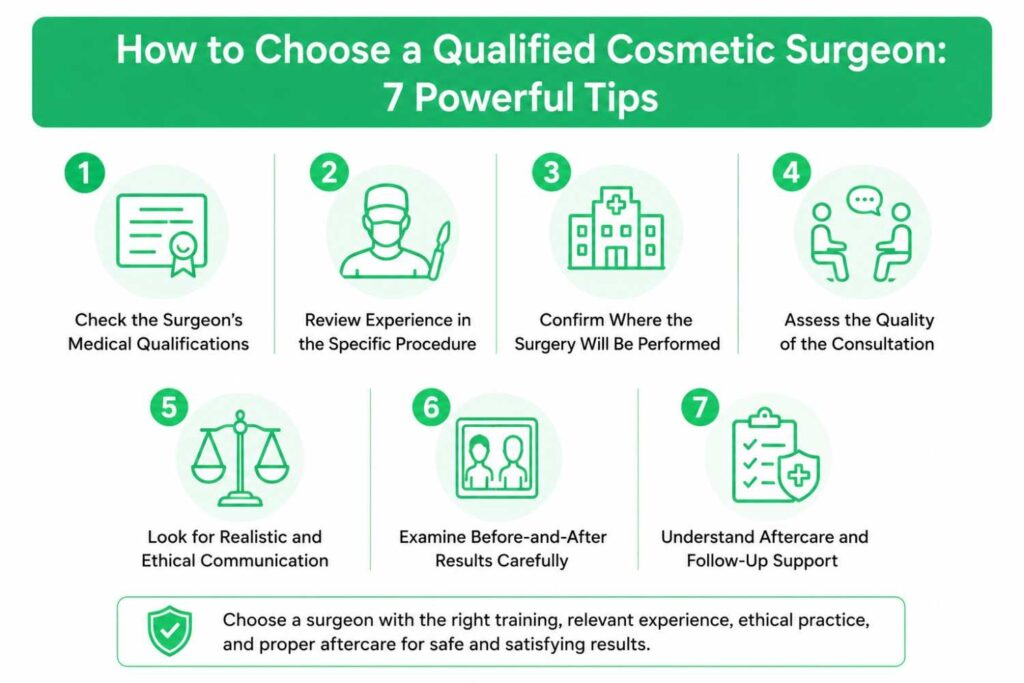
How to Choose a Qualified Cosmetic Surgeon: 7 Powerful Tips
1. Check the Surgeon’s Medical Qualifications
The first step in How to Choose a Qualified Cosmetic Surgeon is reviewing the doctor’s education and surgical training.
A cosmetic surgeon should have recognised medical qualifications and appropriate postgraduate training in plastic, reconstructive, or aesthetic surgery. Qualifications should be clearly stated and reasonably easy to verify.
Look for information about:
- Basic medical degree
- Postgraduate surgical training
- Plastic surgery qualifications
- Specialist registration
- Professional memberships
- Fellowships or advanced training
- Continuing medical education
- Hospital affiliations
Do not rely only on the word “cosmetic” in a clinic name. Different healthcare professionals may use aesthetic terminology, but their training and legal scope of practice can vary considerably.
A good surgeon should be comfortable explaining their qualifications without becoming defensive or avoiding the question.
2. Review Experience in the Specific Procedure
A surgeon may be highly experienced in one area but perform another procedure less frequently. Therefore, How to Choose a Qualified Cosmetic Surgeon also involves checking procedure-specific experience.
For example, a surgeon experienced in reconstructive microsurgery may have a different clinical focus from one who regularly performs facial cosmetic surgery, body contouring, or breast procedures.
Ask questions such as:
- How often do you perform this procedure?
- How many years have you performed it?
- Do you regularly handle similar cases?
- Have you treated patients with my body type or concern?
- Do you perform revision procedures?
- What complications have you encountered?
- How are complications managed?
Experience does not guarantee a particular outcome. However, relevant experience may help a surgeon assess anatomical differences, plan appropriately, manage unexpected findings, and guide recovery.
3. Confirm Where the Surgery Will Be Performed
Hospital quality is a major part of How to Choose a Qualified Cosmetic Surgeon.
A qualified doctor should perform surgery in an appropriate clinical environment with suitable operating facilities, sterilisation systems, anaesthesia support, monitoring equipment, trained staff, and emergency protocols.
Before agreeing to treatment, confirm:
- The name of the hospital or surgical centre
- Whether the operating theatre is properly equipped
- Who will provide anaesthesia
- Whether qualified nursing staff will be present
- What monitoring equipment is available
- Whether emergency support is accessible
- Where you will recover after surgery
- Whether an overnight stay may be required
Minor procedures may sometimes be performed under local anaesthesia in a suitable clinical setting. More extensive procedures should take place in a facility capable of supporting the level of care required.
Do not assume that a stylish consultation room reflects the quality of the operating facility.
4. Assess the Quality of the Consultation
The consultation provides valuable information about the surgeon’s professionalism, communication, ethics, and treatment philosophy.
When learning How to Choose a Qualified Cosmetic Surgeon, pay attention to how the doctor speaks with you, not just what the doctor recommends.
A good consultation should include:
- A discussion of your main concerns
- Review of your medical history
- Details about previous surgeries
- Information about allergies and medications
- A physical examination when appropriate
- Discussion of treatment alternatives
- Explanation of expected results
- Review of possible risks
- Recovery guidance
- Time for questions
The surgeon should help you understand both what surgery may improve and what it cannot realistically achieve.
Be cautious when a consultation feels rushed, sales-focused, dismissive, or designed to make you book immediately.
5. Look for Realistic and Ethical Communication
Responsible communication is essential when deciding How to Choose a Qualified Cosmetic Surgeon.
No surgeon can guarantee perfection. Human anatomy, tissue quality, healing patterns, scarring, lifestyle, age, and medical conditions can all influence results.
Ethical surgeons generally:
- Use realistic language
- Explain limitations clearly
- Avoid guaranteed outcomes
- Discuss scars honestly
- Explain possible complications
- Recommend alternatives when appropriate
- Refuse unsuitable procedures
- Allow time for decision-making
- Avoid unnecessary treatment
- Encourage informed consent
A qualified surgeon may sometimes advise against surgery. This can happen when expectations are unrealistic, medical risks are too high, a non-surgical option is more suitable, or the requested change may not provide a balanced result.
The ability to say “no” when necessary is often a sign of responsible clinical judgement.
6. Examine Before-and-After Results Carefully
Before-and-after photographs can help you understand a surgeon’s general approach. However, they should be reviewed carefully and should not be treated as a promise.
When using images to assess How to Choose a Qualified Cosmetic Surgeon, look for:
- Patients with concerns similar to yours
- Consistent lighting and positioning
- Different stages of recovery
- Natural-looking proportions
- Visible scar placement where relevant
- Results from multiple patients
- Clear explanations of individual differences
Photographs shared online may be edited, filtered, cropped, or selectively chosen. During consultation, ask whether you can view additional examples of the surgeon’s own work.
Remember that another patient’s result cannot predict your exact outcome. Your anatomy, skin quality, healing ability, medical history, and procedure plan will be different.
7. Understand Aftercare and Follow-Up Support
Surgery does not end when the procedure is completed. Proper recovery support is a critical part of How to Choose a Qualified Cosmetic Surgeon.
Ask what happens after the operation.
Important aftercare details include:
- Dressing and wound-care instructions
- Pain-management guidance
- Medication information
- Activity restrictions
- Follow-up appointment schedule
- Emergency contact details
- Advice about swelling and bruising
- Scar-care recommendations
- Return-to-work guidance
- Long-term review
A reliable surgeon should explain which symptoms are expected and which require urgent attention.
Structured aftercare allows the clinical team to monitor healing, identify concerns early, adjust treatment when necessary, and support the patient throughout recovery.
Types of Cosmetic Surgeons and Surgical Expertise
Patients may encounter doctors with different areas of interest. Understanding these areas can help when researching How to Choose a Qualified Cosmetic Surgeon.
Facial Cosmetic Surgery
Facial cosmetic surgery may include procedures involving the nose, eyelids, ears, facial contours, ageing changes, and facial fat distribution.
Common procedures include:
- Rhinoplasty
- Face lift
- Neck lift
- Blepharoplasty
- Otoplasty
- Facial fat grafting
- Chin correction
A surgeon working in facial aesthetics should understand facial proportions, symmetry, expression, skin quality, and scar placement.
Body-Contouring Surgery
Body-contouring procedures reshape areas affected by localised fat, excess skin, pregnancy, weight changes, or ageing.
Procedures may include:
- Liposuction
- Tummy tuck
- Arm lift
- Thigh lift
- Post-weight-loss contouring
- Fat grafting
When evaluating How to Choose a Qualified Cosmetic Surgeon for body contouring, ask about surgical planning, fluid management, blood-clot prevention, compression garments, mobility, and recovery.
Breast Cosmetic Surgery
Breast cosmetic surgery may be performed to change volume, shape, position, symmetry, or proportion.
Options can include:
- Breast implant surgery
- Breast reduction
- Breast lift
- Implant revision
- Breast reconstruction
The surgeon should explain implant or surgical options, incision placement, scarring, recovery, possible future procedures, and long-term monitoring.
Reconstructive and Cosmetic Surgery
Some plastic surgeons perform both reconstructive and cosmetic procedures. Reconstructive experience may involve trauma, burns, congenital conditions, nerve injuries, cancer-related reconstruction, or tissue defects.
This background can provide broad experience in anatomy, tissue handling, wound healing, and complex surgical planning.
Benefits of Choosing a Qualified Cosmetic Surgeon
Understanding How to Choose a Qualified Cosmetic Surgeon can improve the overall quality of your decision-making.
Potential benefits include:
- Personalised treatment recommendations
- Clear explanation of procedure options
- Better recognition of medical risks
- Appropriate surgical planning
- Access to a trained clinical team
- Proper anaesthesia coordination
- Structured recovery support
- Responsible complication management
- Natural and proportionate treatment goals
- Greater confidence in informed consent
The goal is not to find someone who simply agrees with every request. It is to find a surgeon who understands your concerns and recommends a safe, balanced, and medically appropriate plan.
Treatments a Cosmetic Surgeon May Recommend
A qualified surgeon may recommend surgery, a non-surgical treatment, a staged plan, or no treatment at all.
Possible recommendations include:
Surgical Treatments
- Facial reshaping procedures
- Eyelid surgery
- Body contouring
- Fat removal
- Skin-removal surgery
- Breast surgery
- Hair restoration surgery
- Scar revision
- Reconstructive procedures
Non-Surgical Treatments
Depending on the concern, non-surgical care may include:
- Skin treatments
- Injectable procedures
- Laser-based treatments
- Hair-restoration therapies
- Scar-management techniques
- Medical skincare
- Observation and follow-up
A responsible surgeon should explain why a particular option is suitable and whether its benefits are temporary or long-lasting.
Conclusion
Learning How to Choose a Qualified Cosmetic Surgeon involves more than looking at advertisements, prices, or dramatic photographs. Review the surgeon’s qualifications, procedure-specific experience, hospital facilities, communication, ethical standards, safety protocols, and aftercare plan.
A good surgeon should provide a detailed assessment, realistic recommendations, informed consent, and enough time for you to make a comfortable decision. When exploring cosmetic surgery in Kerala, use these checks to compare your options carefully and choose a professional who places patient safety, responsible planning, natural-looking improvement, and long-term care at the centre of treatment.To learn more about cosmetic and reconstructive plastic surgery, visit the American Society of Plastic Surgeons (ASPS).
FREQUENTLY ASKED QUESTIONS
Sushrutha Institute of Plastic, Reconstructive & Aesthetic Surgery

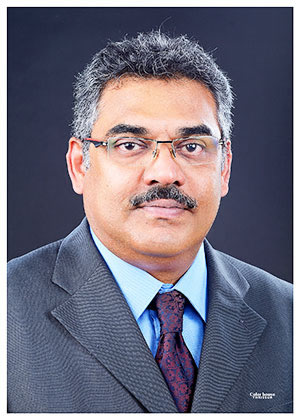
Dr Pradeep Kumar
Plastic, Reconstructive & Aesthetic Surgeon
SIPRAS, Elite Mission Hospital, Thrissur