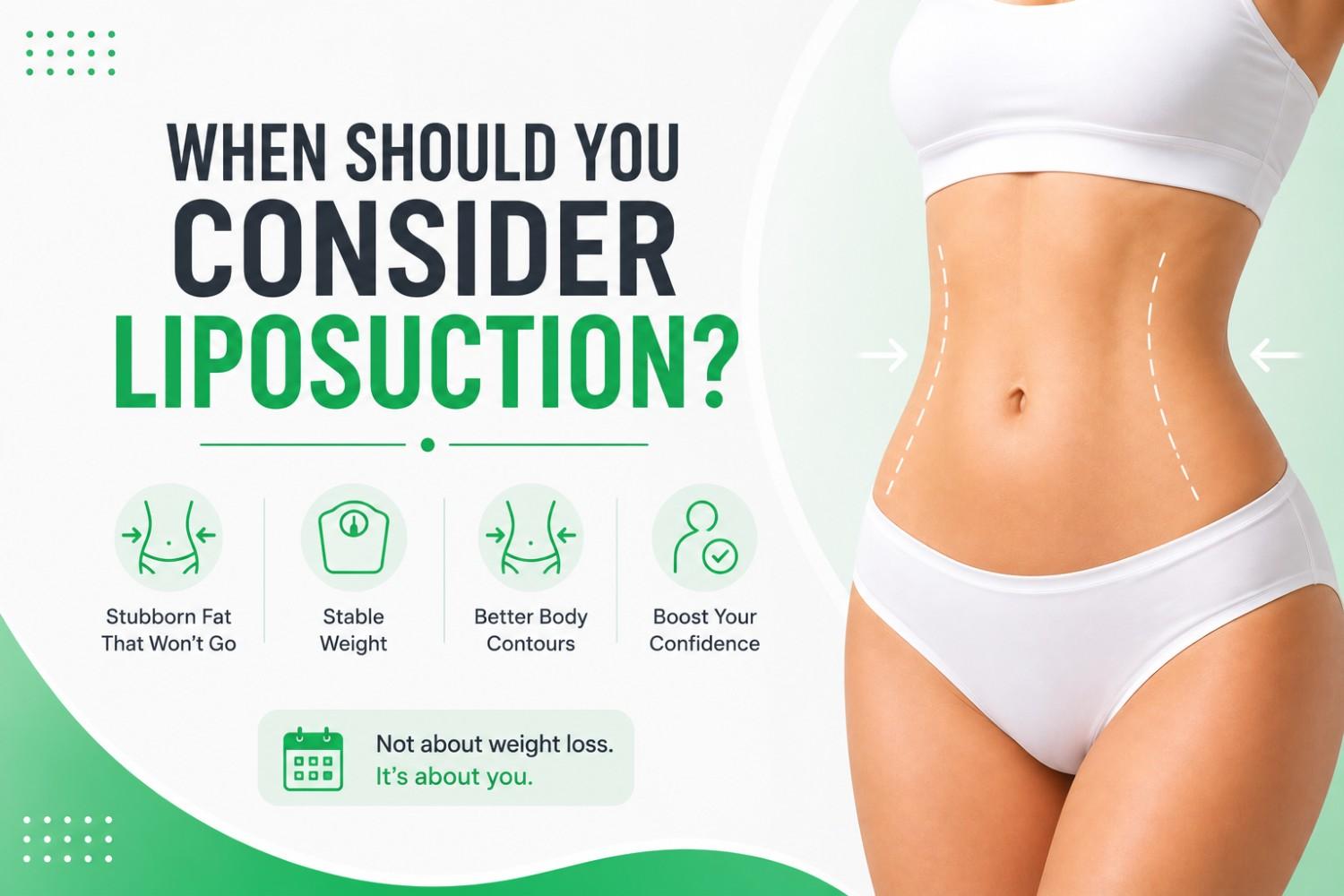
When should you consider liposuction? This is an important question for people who have specific areas of excess fat that remain despite consistent diet and exercise. For someone exploring liposuction surgery in Thrissur, understanding when liposuction may be appropriate can help set realistic expectations before a consultation.
Liposuction is a body-contouring procedure designed to remove selected deposits of fat from specific areas. It is not primarily a weight-loss treatment. Instead, when should you consider liposuction depends on your body shape, fat distribution, skin quality, general health, expectations, and personal goals.
If you are wondering when should you consider liposuction, the answer is not the same for everyone. A qualified plastic surgeon needs to evaluate your individual circumstances before recommending treatment.
So, when should you consider liposuction? In general, it may be worth discussing with a plastic surgeon when you have localized fat deposits that remain noticeable despite maintaining healthy lifestyle habits.
You may consider a consultation if:
- You have specific areas of stubborn fat.
- Your body weight is relatively stable.
- You are generally healthy enough for surgery.
- Your skin has reasonable elasticity.
- You want body contouring rather than major weight loss.
- You understand that results vary between individuals.
- You have realistic expectations about what surgery can achieve.
The question when should you consider liposuction should always be approached as a medical and aesthetic decision rather than a decision based only on photographs or trends.
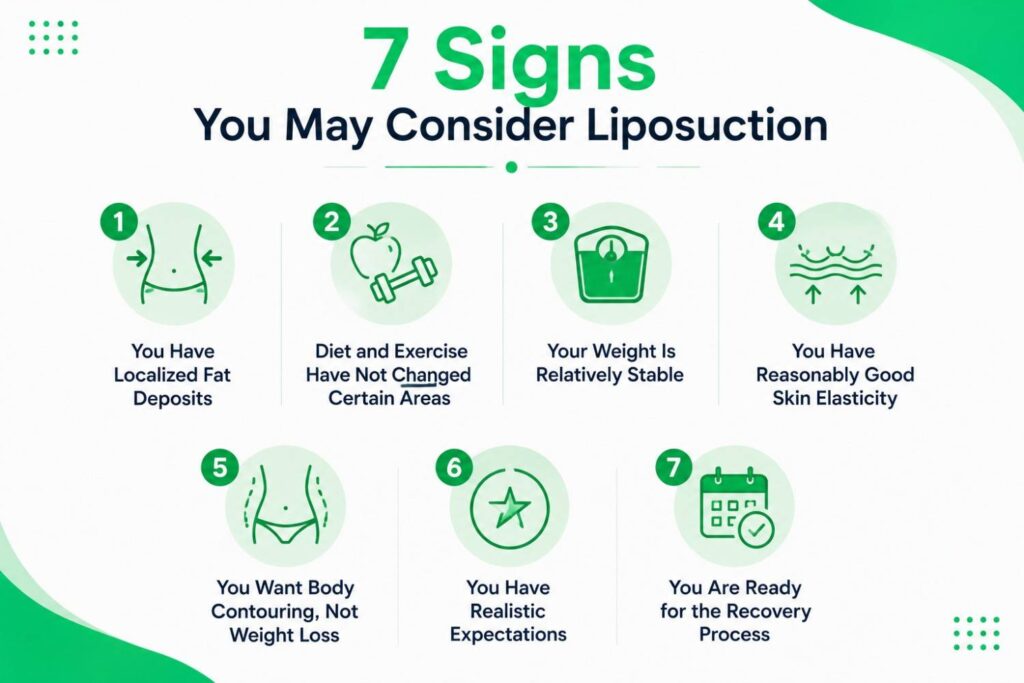
7 Signs You May Consider Liposuction
1. You Have Localized Fat Deposits
One of the clearest reasons to ask when should you consider liposuction is the presence of localized fat deposits.
Some people maintain a relatively stable weight but continue to have noticeable fat pockets around areas such as:
- Abdomen
- Waist
- Hips
- Thighs
- Back
- Upper arms
- Chin and neck
- Other selected areas
These deposits can be influenced by genetics, age, body composition, hormonal factors, and changes in weight.
Liposuction specifically targets selected subcutaneous fat. Therefore, when should you consider liposuction may depend more on the location and characteristics of the fat than on the number shown on a weighing scale.
2. Diet and Exercise Have Not Changed Certain Areas
Another reason people ask when should you consider liposuction is because certain areas seem resistant to lifestyle changes.Healthy eating and regular physical activity remain important for maintaining overall health and body weight. However, they do not always change the distribution of fat in every part of the body.For example, a person may lose weight overall while still noticing a particular fat pocket around the abdomen, waist, thighs, or arms.This does not necessarily mean that lifestyle efforts have failed. Body-fat distribution varies naturally from person to person.In such situations, when should you consider liposuction becomes a question of whether targeted body contouring could address the specific area.
3. Your Weight Is Relatively Stable
When should you consider liposuction? Stable body weight is an important factor.Liposuction is generally intended for body contouring rather than significant weight reduction. If your weight continues to change considerably, the appearance of the treated area may also change after surgery.A relatively stable weight can make it easier for the surgeon to assess your existing body contour and plan treatment.If you are currently trying to lose a substantial amount of weight, your surgeon may recommend focusing on weight management first before considering liposuction.This is why when should you consider liposuction cannot be answered simply by looking at the amount of fat present.
4. You Have Reasonably Good Skin Elasticity
Skin quality is another important consideration when asking when should you consider liposuction.Liposuction removes underlying fat but does not automatically remove large amounts of loose skin. Skin with reasonable elasticity may adapt more effectively to changes in the underlying contour.If significant loose skin is present, liposuction alone may not produce the expected contour. In some cases, another body-contouring approach may need to be discussed.
Your surgeon can assess:
- Skin elasticity
- Skin excess
- Fat distribution
- Muscle tone
- Previous weight changes
- Overall body proportions
Therefore, when should you consider liposuction should include an assessment of both the fat and the skin covering it.
5. You Want Body Contouring, Not Weight Loss
A major point in understanding when should you consider liposuction is knowing what the procedure is designed to do.Liposuction is primarily a body-contouring procedure. Its purpose is to reduce selected fat deposits and improve the contour of specific areas.It should not be considered a replacement for:
- Healthy eating
- Regular physical activity
- Medical weight-management care
- Weight-loss surgery when medically indicated
If your primary goal is to lose a large amount of body weight, liposuction may not be the appropriate approach.However, if your weight is relatively stable and your concern is a specific area of localized fat, discussing when should you consider liposuction with a qualified plastic surgeon may be appropriate.
6. You Have Realistic Expectations
Expectations are extremely important when deciding when should you consider liposuction.Liposuction can change the contour of selected areas, but it cannot guarantee a particular body shape or appearance.The final outcome can be influenced by:
- Skin elasticity
- Amount of fat removed
- Body proportions
- Age
- Weight changes
- Healing response
- Surgical technique
- Lifestyle
A realistic understanding of these factors can help you decide when should you consider liposuction without expecting the procedure to solve every body-shape concern.During consultation, you should be able to discuss what changes are realistically achievable in your individual case.
7. You Are Ready for the Recovery Process
Another important part of deciding when should you consider liposuction is whether you are prepared for recovery.Liposuction is surgery, and recovery takes time. Swelling and bruising can occur during the early healing period, and the final contour may become clearer gradually.Your surgeon may advise you to:
- Wear compression garments when recommended.
- Walk gently when permitted.
- Avoid strenuous activity during the initial recovery period.
- Follow medication instructions.
- Keep incision areas clean.
- Attend follow-up appointments.
- Maintain adequate hydration and nutrition.
Understanding recovery before surgery is essential. If you cannot currently allow enough time for appropriate recovery, it may be better to discuss timing with your surgeon.
When Should You Consider Liposuction After Weight Loss?
People who have lost weight sometimes ask when should you consider liposuction after reaching their target weight.
Generally, the important factors include:
- Weight stability
- Remaining localized fat deposits
- Skin quality
- Overall health
- Realistic expectations
Significant weight loss can sometimes leave loose or excess skin. Liposuction removes fat but does not function as a skin-removal procedure.If loose skin is the primary concern, your surgeon may discuss other body-contouring options rather than relying on liposuction alone.Therefore, when should you consider liposuction after weight loss depends on whether the remaining concern is primarily localized fat, loose skin, or a combination of both.
When Should You Consider Liposuction and What Should You Ask?
Before deciding when should you consider liposuction, prepare questions for your consultation.
You can ask:
- Am I a suitable candidate for liposuction?
- Which areas could be treated?
- What technique would you recommend?
- What type of anaesthesia would be used?
- How much recovery time should I expect?
- What are the possible risks?
- How might my skin respond after fat removal?
- Could loose skin affect the result?
- What follow-up care will I need?
- What should I do before surgery?
A consultation should give you enough information to make an informed decision.
What Liposuction Cannot Do
Understanding what liposuction cannot do is just as important as knowing when should you consider liposuction.
Liposuction does not:
- Replace healthy lifestyle habits.
- Treat obesity by itself.
- Guarantee permanent body weight.
- Automatically tighten significant loose skin.
- Guarantee a specific body shape.
- Prevent future weight gain.
- Remove every type of cellulite.
- Produce identical results for every patient.
The fat cells removed during liposuction are permanently removed from the treated area. However, remaining fat cells can enlarge if substantial weight gain occurs later.
This is why maintaining a stable weight remains important after treatment.
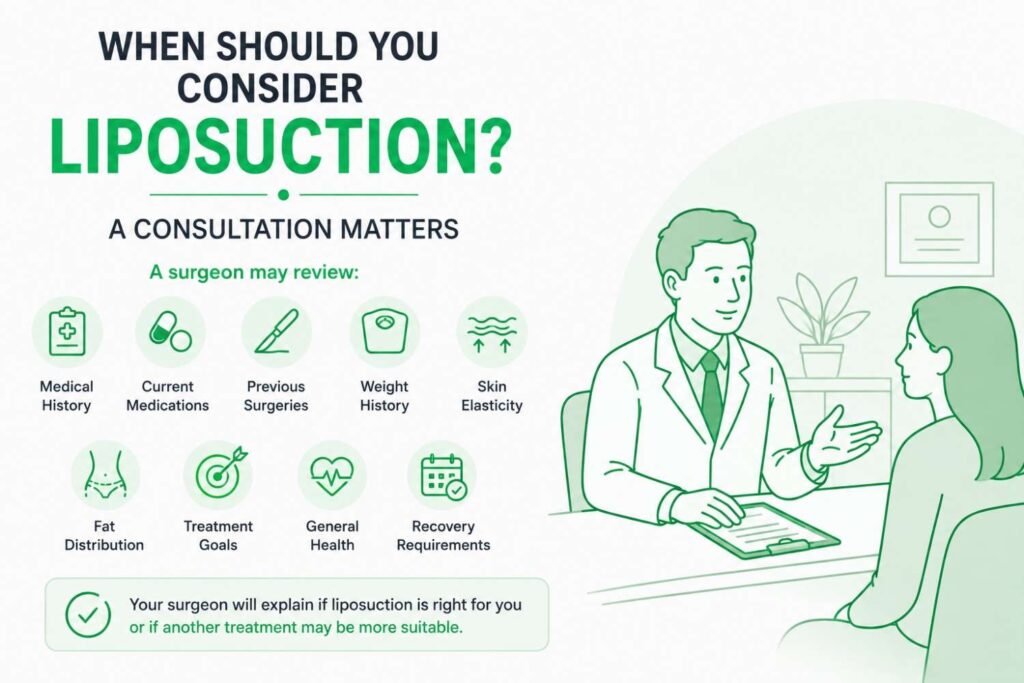
When Should You Consider Liposuction? A Consultation Matters
Even if several signs suggest that you may be suitable, when should you consider liposuction can only be properly assessed through an individual consultation.
A surgeon may review:
- Your medical history
- Current medications
- Previous surgeries
- Weight history
- Skin elasticity
- Fat distribution
- Treatment goals
- General health
- Expected recovery requirements
The surgeon can then explain whether liposuction is appropriate and whether another treatment may better address your concerns.
Conclusion
So, when should you consider liposuction? It may be worth discussing when you have localized fat deposits, relatively stable body weight, suitable skin quality, realistic expectations, and a goal of improving specific body contours rather than achieving major weight loss.Understanding when should you consider liposuction can help you approach the decision more thoughtfully. The procedure is not suitable for everyone, and the right treatment depends on individual anatomy, health, skin quality, fat distribution, and goals.If you are considering liposuction surgery in Thrissur, a consultation with a qualified plastic surgeon can help you understand whether liposuction is appropriate for your specific concerns and what you can realistically expect from the procedure.To learn more about cosmetic and reconstructive plastic surgery, visit the American Society of Plastic Surgeons (ASPS).
FREQUENTLY ASKED QUESTIONS
Sushrutha Institute of Plastic, Reconstructive & Aesthetic Surgery

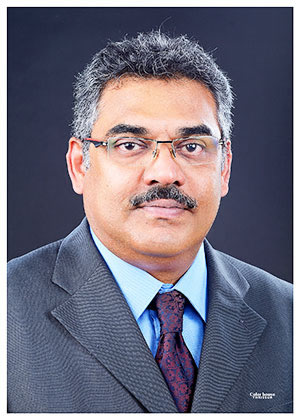
Dr Pradeep Kumar
Plastic, Reconstructive & Aesthetic Surgeon
SIPRAS, Elite Mission Hospital, Thrissur